Part 4: Godox Studio & Location Strobes
Posted by Photogear on 18th Aug 2026
Part 4: Godox Studio & Location Strobes
Powerful flash for the studio, on location, or both: shape light and overpower the sun, from a compact battery strobe to a full mains-powered monolight. Here's the range decoded, and which to actually buy.
Just want one good strobe? The Godox AD200Pro II is the one most photographers should buy: 200Ws, pocket-sized, with two swappable flash heads, so it works as a small on-location kit or a punchy off-camera light. Want serious location power? Step up to the AD400Pro II (our pick for real power at the best value) or the AD600Pro II, the flagship most pros actually need. Need more than that? The AD800Pro tops the whole range at 800Ws.
Building a home studio and don't need to travel? The MS300-V mains monolight is the cheapest way into real studio flash. Want more headroom in that same mains-only family? The SK400III-V, DP Mark III range or QT III range step up from there. Want it even smaller, or building a packable two-light kit? The AD100Pro II and AD300Pro II shrink the battery idea further down.
Battery strobes are what separate a snapshot from a portrait: a single pop of light that can out-power full sun, freeze motion, and shape a face the way an on-camera flash simply can't. Unlike a speedlight, these are built to come off the camera, onto a stand, through a modifier, and to keep punching out full power shot after shot all day. If you shoot portraits, weddings outdoors, or need to control harsh daylight on location, this is the gear that does it. Shoot from a fixed space instead? The mains-powered monolights in this range, the MS300-V and the SK/DP/QT series, give you the same kind of power without needing a battery at all. Every strobe here has full manual power control and 2.4GHz wireless built in, so the real decision comes down to power, mount and whether you ever need to leave a wall socket behind, not features.
Who This Part Is ForAnd who should skip ahead.

This part is for portrait, wedding, location and studio photographers who need real power off-camera: shaping light, fighting the sun, lighting a big space, or running a fixed studio setup. If you mainly shoot video or content, continuous LED will serve you better day to day: jump to Part 2 (LED for creators). And if you only ever need a flash on top of the camera for events, the speedlights in Part 3 (on-camera flash) are lighter and simpler for that job.
How to ChooseAnswer this first, it'll point you to the right section below.
1. Need Power You Can Take Anywhere?
Shooting on location, at weddings, or anywhere without a handy power point.
2. Only Ever Shooting From a Fixed Studio?
Never leaving one space, mains power is simpler and cheaper, with a deep range if you want more headroom.
Portable & Battery StrobesReal studio power that runs on its own battery, from pocket-sized to location flagship.

Every AD-series strobe runs on its own lithium battery, so it works exactly the same on location as it does at your desk. The model number is roughly the Ws output: 100 to 300Ws covers most portrait and indoor work, 400Ws is the sweet spot for serious location use, and 600Ws is for the days you need to properly overpower the sun or light a big space. Only the AD200Pro II ships with two interchangeable heads in the box, a speedlite-style head for a focused beam and a bare bulb head for a wider, softer spread, so it doubles as two different lights from one unit. Recycle time and full-power flash count matter most for events and fast-moving portrait sessions: the AD400Pro II and AD600Pro II recycle fastest at full power, while the AD100Pro II and AD300Pro II trade a little speed for size. Need more than 600Ws? The AD800Pro tops out at 800Ws with a native Bowens mount, a specialist buy for the rare job where nothing smaller cuts it, worth asking about in-store rather than a default recommendation.
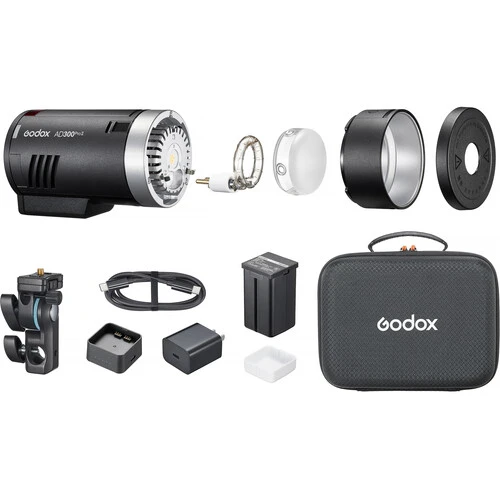
Godox AD100Pro II / AD300Pro II
Shrink the AD-series idea down: real battery power in a body small enough to carry two or three without thinking twice. The AD100Pro II is the pocket option, the AD300Pro II steps up for more punch when you need it.
Shop Godox AD300Pro II →
Godox AD200Pro II
200Ws with a speedlite head and a bare bulb head both included, so it doubles as two different lights depending on the shot. Small enough to carry everywhere, strong enough for real portrait and location work.
Shop Godox AD200Pro II →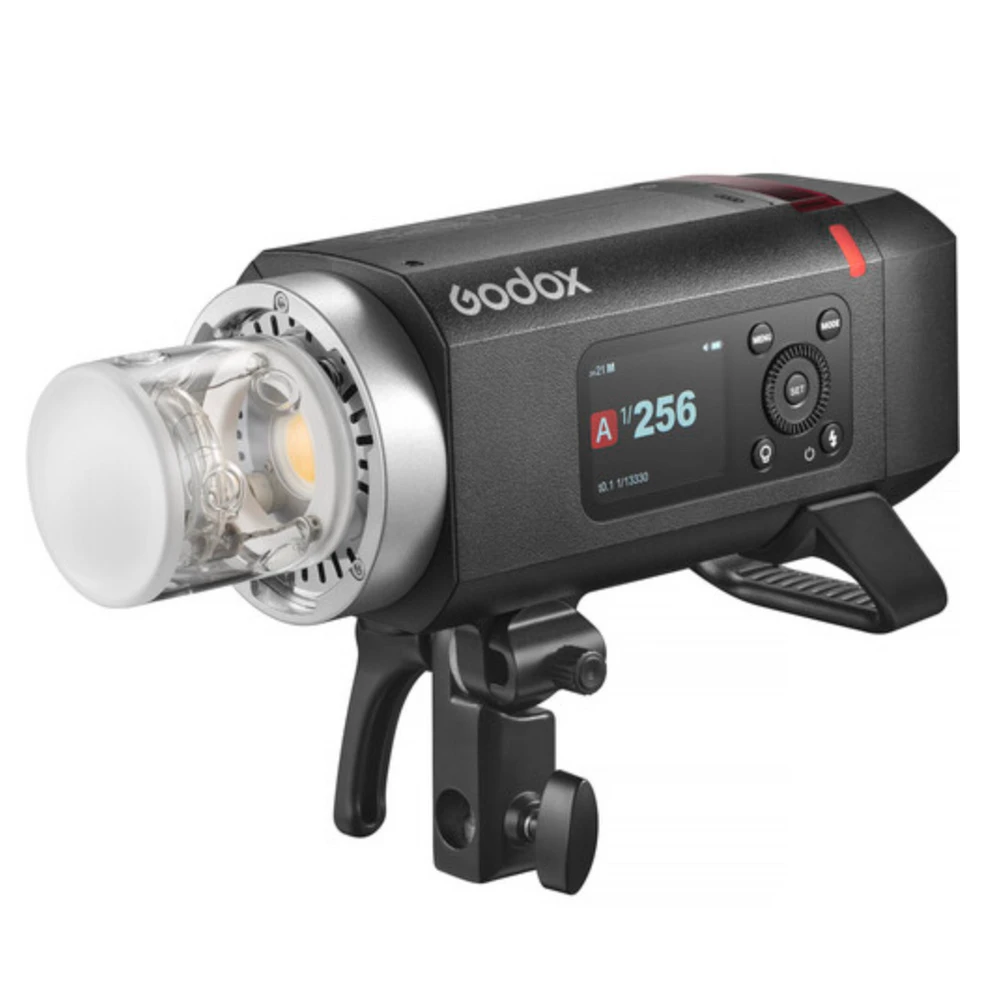
Godox AD400Pro II
400Ws with the fastest recycling for its power in the range, plus a strong bi-colour modeling lamp. The one to buy if you want genuine location power and don't want to compromise on speed.
Shop Godox AD400Pro II →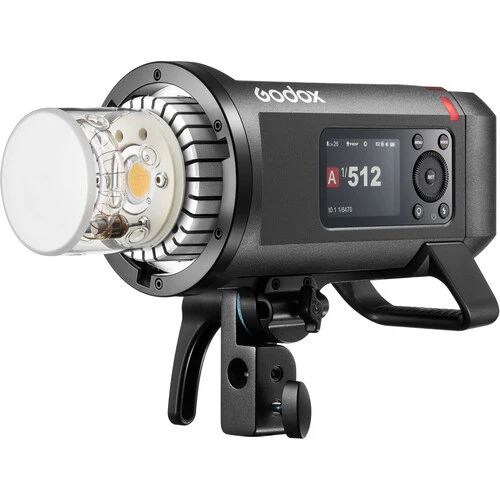
Godox AD600Pro II
The flagship of the everyday AD-series lineup. 600Ws, the deepest power reserve most photographers will ever need, built for the days when nothing smaller will do. (Need more? The AD800Pro tops the whole range at 800Ws, a specialist buy.)
Shop Godox AD600Pro II →Studio MonolightsMains-only power, from the cheapest way in to Godox's advanced, high-speed pro tier.
Every monolight in this section runs on mains power only: cheaper than a battery strobe, and a deep range if you want more headroom, but tied to a wall socket. The Godox MS300-V is the cheapest real way in, with a native Bowens mount and an LED modeling lamp so you can see your light before it fires, best bought as the MS300 Double Kit with a trigger, two softboxes and stands included, rather than the bare head alone. Step up to the SK400III-V for more consistent colour and faster recycling in a similarly simple, beginner-tier unit. The DP Mark III range (400 to 1000Ws) steps up again for intermediate studio work, recycling as fast as 1 second at full power against roughly 1.5 seconds for the SK400. At the top, the QT III range is Godox's advanced, professional tier: manual-only monolights built for speed, recycling in as little as 0.01 seconds with flash durations short enough for high-speed sync up to 1/8000 sec, the pick for freezing fast action or demanding commercial work rather than everyday portraits.
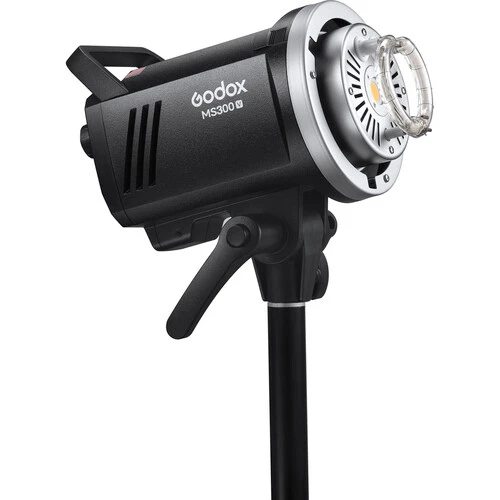
Godox MS300-V
The cheapest real way into studio strobes. Bowens-mount, mains-powered, with an LED modeling lamp so you can see your light before it fires. The MS300 Compact Double Studio Flash Kit, two heads, a trigger and two softboxes with stands, is usually a better way to start than the bare single head below.
Shop MS300 Double Kit → or shop the single head →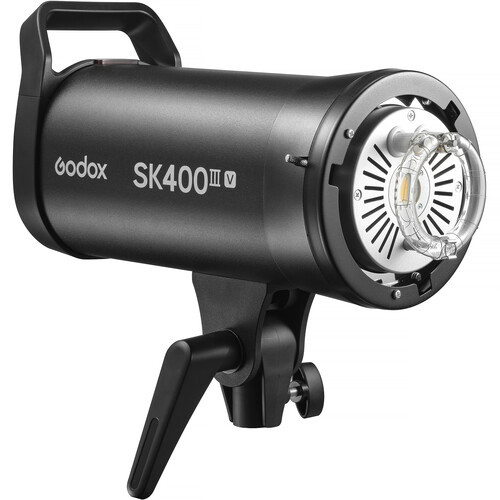
Godox SK400III-V
400Ws with a built-in 2.4GHz receiver, a dimmable 10W LED modeling lamp and a Bowens S mount. Still simple and beginner-friendly, just with faster recycling (0.1 to 1.5 sec) and more consistent output than the MS300-V.
Shop Godox SK400III-V →
Godox DP Mark III range (400 to 1000Ws)
Four sizes from the DP400III-V up to the DP1000III-V, each with a 150W COB LED modeling lamp and recycling as fast as 1 second at full power. The DP400III-V is the entry point into this tier; step up through the DP600III-V and DP800III-V to the DP1000III-V for the most output before the QT range.
Shop Godox DP Mark III range →
Godox QT400IIIM / QT1200IIIM
Manual-only, self-contained monolights built for speed rather than everyday portraits: recycle as fast as 0.01 to 0.9 seconds, with flash durations short enough to support high-speed sync up to 1/8000 sec. The QT400IIIM starts the range at 400Ws, the QT1200IIIM tops it out at 1200Ws, Godox's most powerful monolight.
Shop Godox QT400IIIM →The One That Ties It Together
Whatever power you land on, every strobe here, and every monolight, speaks the same 2.4GHz Godox X system as your flashes and LED lights, so growing from one light to a full three-light kit never means re-buying triggers. See Part 6.
Quick ComparisonThe decision-relevant specs, side by side. Check each product page for full details.
| Model | Power | Battery | Mount | Best for |
|---|---|---|---|---|
| Portable & Battery Strobes | ||||
| AD100Pro II | 100Ws | Li-ion (built-in) | Round head, magnetic | Pocket travel kit |
| AD300Pro II | 300Ws | Li-ion (built-in) | Round head, Bowens adapter | Compact two-light kit |
| AD200Pro II | 200Ws | Li-ion (built-in) | Speedlite + bare bulb heads | Best all-round strobe |
| AD400Pro II | 400Ws | Li-ion (detachable) | Round head, Bowens adapter | Location, best value at power |
| AD600Pro II | 600Ws | Li-ion (detachable) | Round head, Bowens adapter | Flagship, big spaces |
| AD800Pro | 800Ws | Li-ion (detachable) | Bowens (native) | Maximum power, specialist use |
| Studio Monolights | ||||
| MS300-V | 300Ws | Mains only | Bowens (native) | Home studio, no travel |
| SK400III-V | 400Ws | Mains only | Bowens S mount | Beginner tier, step up from MS300-V |
| DP400III-V | 400Ws | Mains only | Bowens S Type | Intermediate, entry point |
| DP600III-V | 600Ws | Mains only | Bowens S Type | Intermediate, more headroom |
| DP800III-V | 800Ws | Mains only | Bowens S Type | Intermediate, big studio jobs |
| DP1000III-V | 1000Ws | Mains only | Bowens (front) | Top of the intermediate range |
| QT400IIIM | 400Ws | Mains only | Bowens (front) | Advanced, freeze-action entry |
| QT1200IIIM | 1200Ws | Mains only | Bowens (front) | Advanced, maximum output |